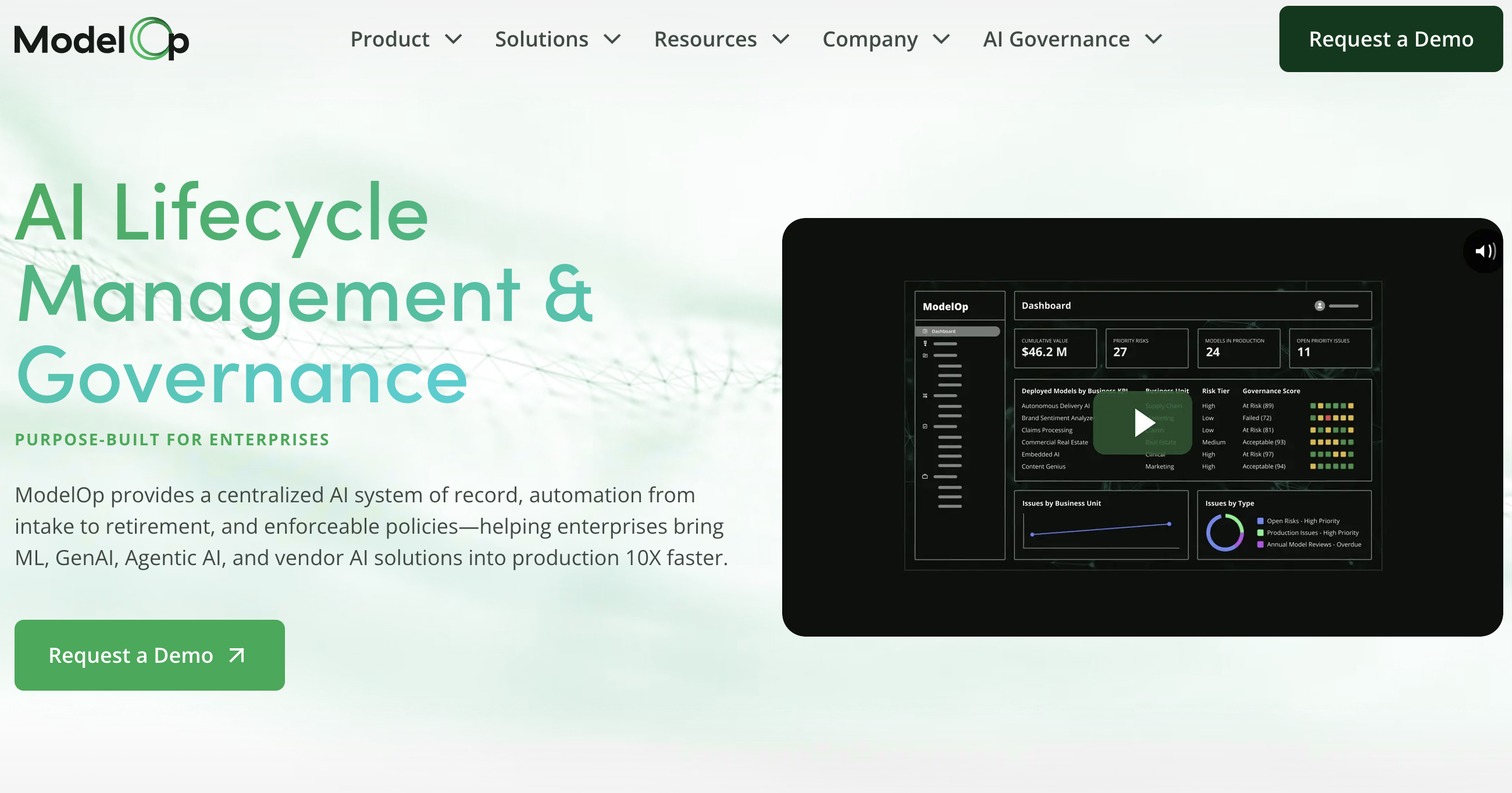
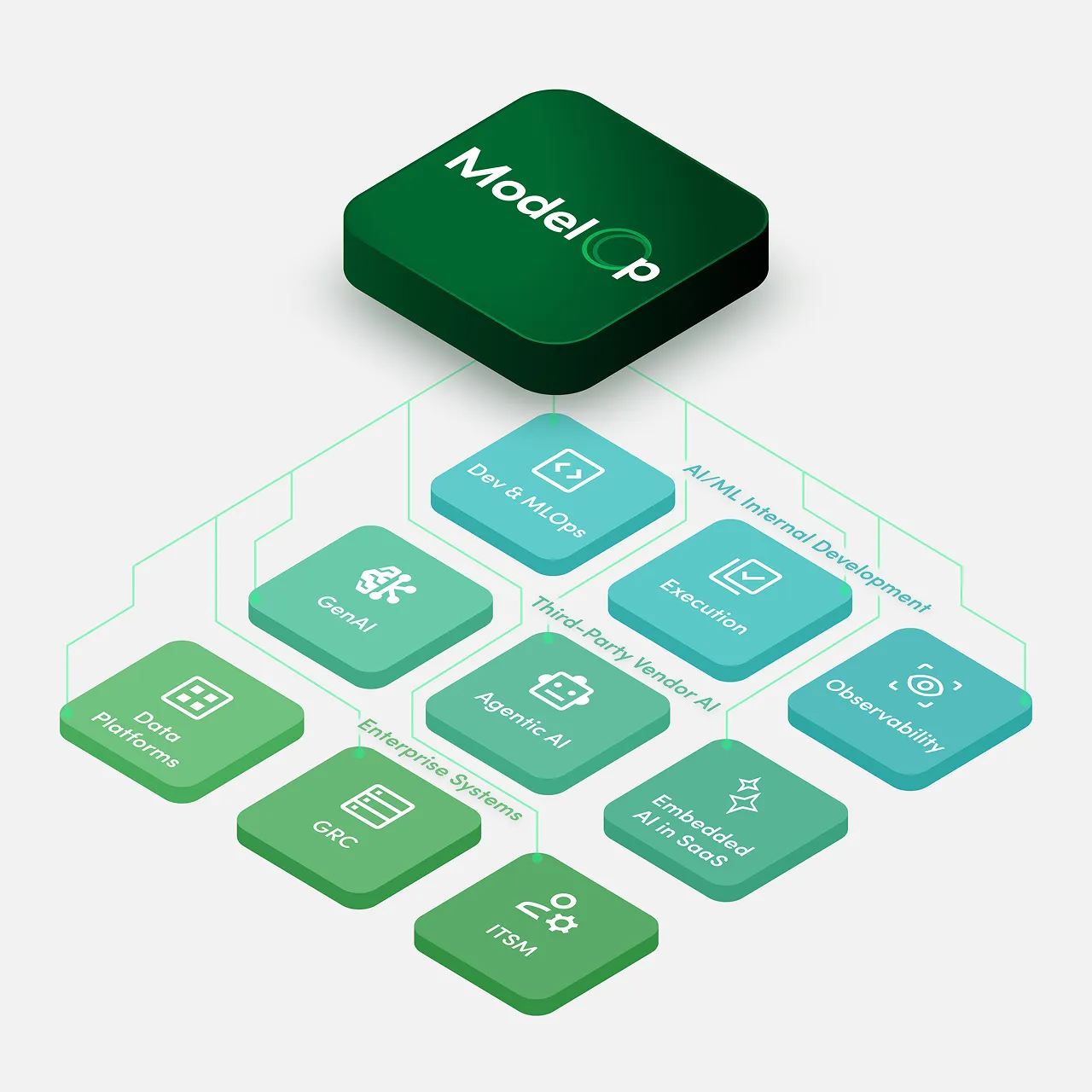
ModelOp is the leading AI lifecycle management and governance platform helping enterprises bring ML, GenAI, Agentic AI, and vendor AI into production
ModelOp appears to be appreciated for its capabilities in AI and machine learning model management, reflecting a robust framework that supports enterprise-level deployments. However, there seems to be a lack of direct, specific feedback within available user-generated content, potentially indicating limited widespread community discussion. Pricing information and sentiment are not explicitly detailed in the reviewed content, leaving uncertainty about cost-effectiveness. Overall, ModelOp holds a reputation as a specialized tool with niche utility in advanced AI applications, but with minimal public discourse or community engagement apparent in social platforms.
Mentions (30d)
20
4 this week
Reviews
0
Platforms
2
Sentiment
0%
0 positive
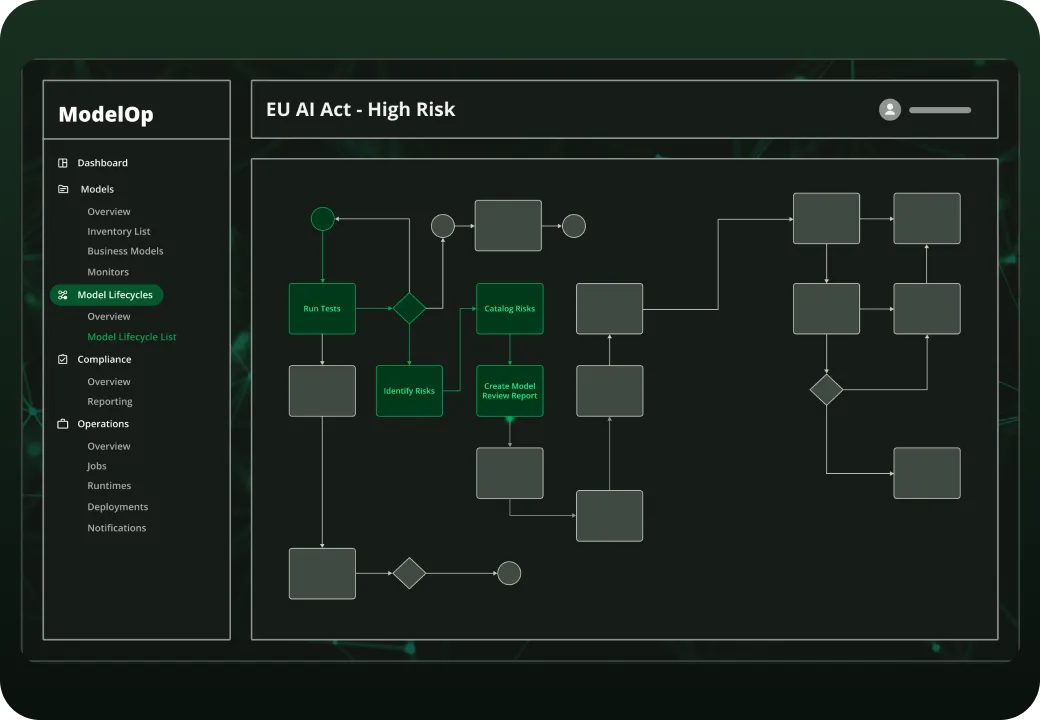
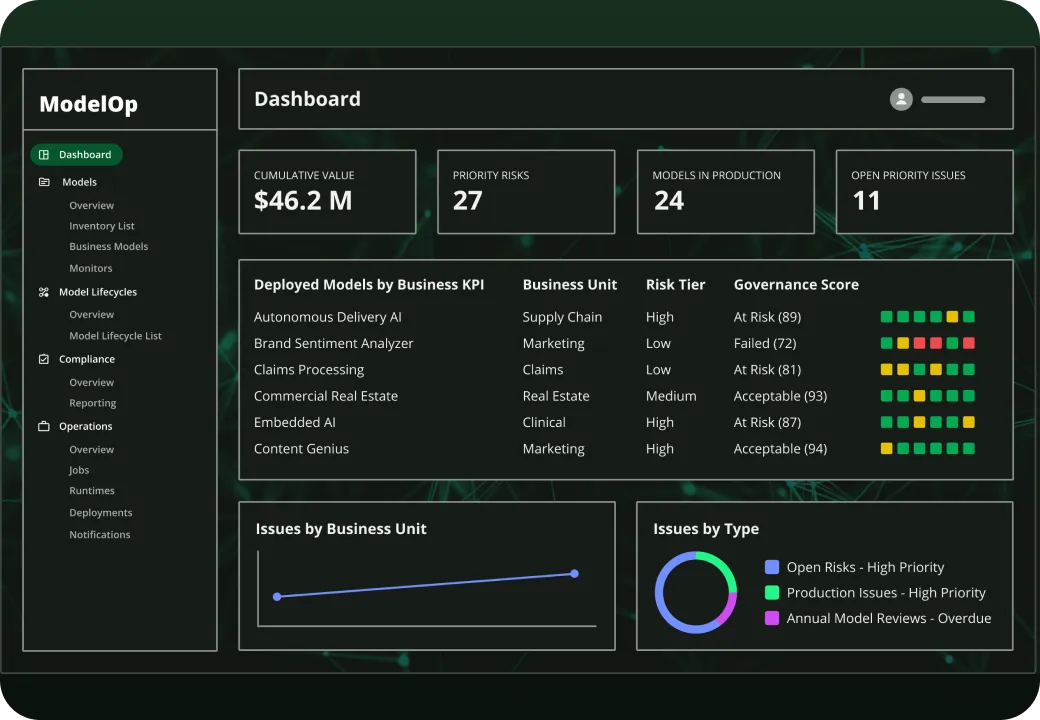
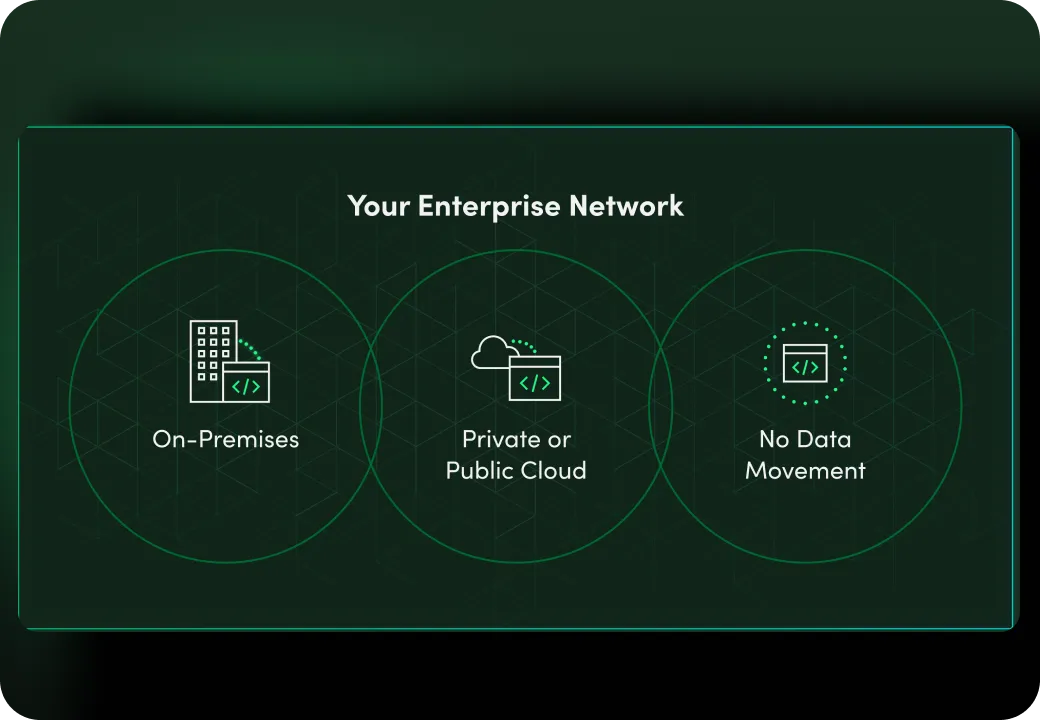
ModelOp appears to be appreciated for its capabilities in AI and machine learning model management, reflecting a robust framework that supports enterprise-level deployments. However, there seems to be a lack of direct, specific feedback within available user-generated content, potentially indicating limited widespread community discussion. Pricing information and sentiment are not explicitly detailed in the reviewed content, leaving uncertainty about cost-effectiveness. Overall, ModelOp holds a reputation as a specialized tool with niche utility in advanced AI applications, but with minimal public discourse or community engagement apparent in social platforms.
Features
Use Cases
Industry
information technology & services
Employees
44
Funding Stage
Series B
Total Funding
$16.0M
Cloudflare just shipped enterprise MCP governance, is this where the industry is heading or does anyone care
Cloudflare wrapped Agents Week last week and the enterprise MCP stuff caught my eye, want to see what people think. They shipped a few things. MCP server portals that aggregate multiple upstream servers behind Cloudflare Access auth, Code Mode that collapses thousands of API endpoints into two tools (search and execute) running in a sandboxed Worker and drops context costs by 99.9%, AI Gateway sitting between MCP clients and model providers for usage tracking, plus shadow MCP detection added to Cloudflare Gateway as a category to watch. What I cant tell yet is whether anyone outside Cloudflare cares. The SaaS vendors whose MCP endpoints we connect to are mostly shipping with no controls, licensing is all or nothing, no server allowlists, agent actions don't show up in any audit log you can actually query. Admin panel basically says "enable AI: yes/no" and that's the whole governance surface. Which kind of makes sense if you think about who's driving adoption. Not the vendor pushing, users pulling. For example marketing wants personalized follow-ups for conference registrants, someone wires up ChatGPT with MCP connections to the marketing automation tool, the CRM, and the event platform. One prompt. "pull everyone who registered but didnt show, segment by job title, draft three different messages for each segment, schedule them in HubSpot." Done in 20 minutes, thing the ops team would have spent two days on. CMO sees it and asks why everyone isn't doing this. So two ways this plays out probably. Either SaaS vendors get pressured into shipping their own governance and the control plane lives at the app layer, or the governance layer just permanently lives at the network edge with infrastructure providers like Cloudflare and SaaS vendors stay all-or-nothing because they don't have to fix it. Neither is obviously right. The infrastructure-layer approach is faster to ship and centralizes visibility, the app-layer approach gives you per-feature granularity that network-level controls can't really match. wonder what people running SaaS MCPs at work are actually doing. is anyone testing the Cloudflare portal stuff? building your own gateway? or just running unmanaged and assuming this all sorts itself out?
View originalAGI delayed indefinitely: I watched a frontier model boot a Linux container and write a Python script to count the letter "a" in a word I misspelled on purpose
AGI by 2027. Meanwhile, today: the world's smartest model needs DevOps to count vowels. that's not intelligence, that's anxiety with a compute budget The model - the one that's supposedly 18 months away from automating the economy - paused, announced "Let me settle this definitively with code," spun up an entire sandboxed compute environment, wrote a script, executed it, read the output, and came back with "I'm going to hold my ground on this one." The singularity timeline remains intact. But today, right now, the absolute frontier of machine cognition is s-t-r-a-w-b-a-r-r-y. submitted by /u/nikanorovalbert [link] [comments]
View originalA small CLAUDE productivity hack that has been surprisingly useful for me.
Hey guys 👋 We all struggle with the 5-hour reset, especially as token usage gets higher with the newer models. So I started using a simple workflow to maximize my productivity. Using this scenario: If my usage resets at 3:00am (when I’m asleep) and I don’t wake up until 7:00am, I used to lose those four hours completely. My next prompt wouldn’t get sent until I sat down at my computer in the morning. If I submitted my first prompt at, let’s say, 7:17am, that’s effectively when my working window would begin. Now, before going to bed, I prepare the next task and use a simple auto-clicker to submit it exactly when the reset happens. By the time I wake up, the analysis, audit, code review, or report is already waiting for me. Using the same example, if the reset happens at 3:00am, I’ve already been making progress for four hours while sleeping. When I wake up at 7:00am, I can immediately review the results and continue with the next step instead of spending the morning waiting for the first task to finish. The biggest benefit isn’t getting more usage, your limits stay exactly the same. The benefit is maximizing the time window you already have. Instead of losing several hours of potential work time, you’re making full use of the window that would otherwise be wasted. For larger projects, those hours add up quickly. It feels a bit like handing work off to a teammate overnight and coming back to progress already made. Overall, the project simply moves faster. Curious if anyone else has found similar ways to make better use of their Claude usage windows! submitted by /u/Emergency_Tea15 [link] [comments]
View originalClaude x Codex combination is slow but time + money saving on the long run
I love Claude Code and Spent 600 USD when it came out without plans back in early 2025 and has been on Max-20x eversince but even with latest models like Opus 4.8 it tries to take shortcuts which my revenue generating products can't afford and manually getting specs and plans reviewed by Codex + Grok CLI was not time saving at all. So I posted here (my last post) I got more downvotes than upvotes + most people undermined my skills and abilities although I have been building tools and working as DevOps Engr for over half a decade. Only 1 person mentioned Codex Plugin which saved my time but as always I customized its integration to be universal in all of my git initd projects. + I added this nice Allow/Armed/Blocked which tells me the state of Codex reviews. If it says allow it means the review went pretty well. Now I am working on building similar solution for Grok inclusion as it has been providing quite useful input along with Codex and I don't want to leave any gaps. Oh sorry forgot to mention how it is saving me time, usually if I rushed a task without consulting other AI agents or reviewing it myself, I would end up with drifts and friction resulting in many more attempts and coming back to the same problem which I fixed a few hours or a few days ago.. Now if once the specs and plans are clean and then Code is also reviewed by Codex, I can literally forget about the problem if it ever existed... I know even if claude with clean context reviewed the plans it would be able to improve that but I didn't want that. I wanted different eyes and honestly Codex does a lot better job of going thro whole codebase and ensuring there would be no drift once the plan goes through or the code is deployed. https://preview.redd.it/x92m7slm4e5h1.png?width=1964&format=png&auto=webp&s=6872061d9b7a7af29b8c2b09c75a7820fda2fdd6 submitted by /u/raiansar [link] [comments]
View originalDoing a full Claude rollout for a small business with no technical background — what am I missing?
Background on me: I work across strategy, operations, and whatever-needs-doing at a small consumer product company. My actual background is in post-production — which, as it turns out, has a surprising amount of overlap with systems thinking, asset management, naming conventions, versioning, and workflow design. I’m not a developer, not a PM, not particularly technical. I’m just someone who finds this stuff interesting and has ended up being the person who is building it in this instance Over the past few months I’ve been doing a fairly comprehensive Claude rollout for our business. We’re a team of around 20 people across a few regions, and I’ve been building this mostly alone, learning as I go. Here’s roughly what’s been built or is in progress: • Department-level Claude projects for most of the business (CS, marketing, product, ops, wholesale, finance) — each with tailored instructions, knowledge bases, and relevant integrations • Document environment rebuild from scratch alongside this — new folder architecture, naming conventions, permissions model — so Claude has a clean, searchable environment to work within • DAM setup (separate from documents — creative assets only) with a mirrored folder logic • Automated reporting pipeline in design phase — scripted integration pulling from platform APIs through Claude to generate and write reports back to a central location • A specific operational workflow (line sheets) using Claude + Canva • Individual staff Claude setups with compiled briefing documents as knowledge base files Much of this is still in progress. The infrastructure work is probably 60% done. Some things are live, most are built but not yet populated, a few are still on paper. What I’m asking: For people who’ve done something similar — what would you add? What have I not thought of that turned out to be high-value? What integrations or use cases surprised you? Does the overall approach make sense? Thanks submitted by /u/ChestnutIceCream [link] [comments]
View originalSmall AI Consultancy Accepted Into Anthropic Partner Program — How Are Others Handling the 10-Person Requirement?
We’re a small AI consulting team that has been building with Claude for client work over the past year, mainly around agent workflows, MCP integrations, automation, and full-stack AI products. We recently applied to the Anthropic Partner Program and got accepted, which was exciting because Claude is already central to a lot of our work. The part we’re trying to figure out now is the 10-person requirement. We’re not a large agency, so instead of hiring just to hit a number, we’re trying to build a bench of qualified independent specialists. The idea is to bring together people with different strengths — full-stack, DevOps, agent architecture, healthcare AI, manufacturing/security, and enterprise implementation — and have everyone complete the Anthropic Academy courses. We’ve started reaching out to independent devs, fractional CTOs, and AI consultants. Some people are interested, but the hard part is figuring out how to structure it properly so it feels credible and useful, not just like a loose group of contractors. For anyone who has gone through this: Have you used outside independents to meet the 10-person requirement? How long did the Anthropic Academy courses take? Is there any partner community or Slack where people are sharing notes? For small AI consultancies, does this “certified bench” model make sense? Would appreciate any practical advice from others working through the same process. submitted by /u/New_Commission_5841 [link] [comments]
View originalI ship AI agents in production. The mess is MCP.
Been building agents for clients across logistics, fintech, and a few indie SaaS shops for about a year and a half. Most of what gets written about AI agents online doesn't match the day-to-day. The day-to-day is mess. One specific kind of mess: MCP servers in production. Three months ago a client asked me to wire Claude Code into their internal workflow. Sales ops team, 8 people. They'd already installed five MCP servers themselves off YouTube tutorials, Stripe, Salesforce, Slack, Google Drive, internal Postgres. Plus a custom one their previous contractor wrote. Six servers, ~180 tools. Day one I sat down to use the setup myself. Context bar was orange before I'd typed a single thing. Tool selection was actively wrong. Asked Claude to "find the most recent invoice for Acme" and it called slack_search_messages instead of stripe_invoices_list. Why? The Slack MCP's search tool description was twice as long and had the word "find" in it three times. That's MCP in production. Things nobody warned this client about: Tool descriptions are your prompt now Every tool description from every MCP server lands in the system prompt every turn. One Salesforce custom-object tool had a 1,200-token description, bigger than my entire actual system prompt. Half of it was marketing copy from the MCP author.. Order matters more than it should Models bias toward tools listed first. The Postgres MCP was listed last because they'd added it most recently. So when there was an obvious DB query, the model kept reaching for Salesforce instead because it was at the top… OAuth is a nightmare Two of the six servers were HTTP/SSE with OAuth. The previous contractor set them up on his laptop. Tokens lived in his home directory, he'd left the company three months earlier. Nobody could re-authorize anything because nobody had ever run the auth flow themselves Context cost compounds silently This client was on Sonnet, ~400 model calls a day across the team. Cold-start tokens from MCP definitions were ~42k per turn. Cache helps when prefixes match but they were rotating MCP usage all day, so cache hit rate sat around 30%. Bill was ~$1,400/month before doing any actual model work. They thought it was just the model being expensive. What we did: Stripped every MCP tool description down to one sentence. Saved ~12k tokens per turn just from that Moved 3 of the 6 MCPs from -scope user to -scope project so they only loaded when actually needed Put a gateway in front of the always-on ones so Claude sees search_tools / invoke_tool / auth instead of every tool directly. Used Ratel for this (github.com/ratel-ai/ratel, open source, in-process). Tool selection accuracy went from ~70% to ~95% on a sample of their actual queries The "AI" part is easy. The "you've stuffed every MCP server you've found into one Claude config and now your model is picking the wrong tools and your bill is $1,400/month" part is the actual job. If you're shipping agents that touch MCP in production: Audit tool descriptions before you add a server Use -scope project for anything that isn't truly cross-cutting Assume tool selection will fail past 50 tools and plan for it Centralize OAuth before a contractor leaves with the only working tokens Is anyone else shipping this stuff and running into the same things, or is this just my client pool? submitted by /u/AbjectBug5885 [link] [comments]
View originalWe wrote an open-source interactive playbook for Agentic DevOps (How to move multi-agent systems from local notebooks to production).
Hey everyone, If you’ve built a multi-agent system, you already know the painful truth: wiring nodes together locally is fun, but deploying them is an absolute infrastructure nightmare. When a standard app fails, it throws a 500 error. When an autonomous swarm fails, it can get stuck in a ReAct loop, hallucinate an answer, and quietly burn through your API budget without triggering a single traditional alert. Standard DevOps practices don't natively map to stochastic AI outputs. We just published a massive, no-fluff playbook on the AgentSwarms blog detailing exactly how to build an Agentic DevOps pipeline using entirely open-source tooling. Here is what we cover in the playbook: Observability & Tracing: Why standard logging fails, and how to implement open-source tracing to capture the state, prompt, token count, and latency at every single node handoff. Test-Driven Prompt Evals (CI/CD): You can't just change a system prompt based on "vibes" and push it to main. We break down how to run matrix evaluations against historical user inputs before deployment to catch regressions instantly. Deterministic Guardrails: How to implement middleware that scrubs PII and blocks destructive code execution before the LLM even sees the state. Cost Control & Routing: How to prevent vendor lock-in and implement dynamic routing to keep token economics from destroying your cloud budget. If you are currently wrestling with the deployment phase of your AI projects, I highly recommend giving this a read. It focuses entirely on open-source solutions so you don't have to sign a massive enterprise contract just to get visibility into your swarms. Would love to hear what open-source tools you guys are currently slotting into your LLMOps pipelines! Link: https://agentswarms.fyi/blog/devops-for-agentic-ai-open-source-playbook submitted by /u/Outside-Risk-8912 [link] [comments]
View originalWe wrote an open-source interactive playbook for Agentic DevOps (How to move multi-agent systems from local notebooks to production).
Hey everyone, If you’ve built a multi-agent system, you already know the painful truth: wiring nodes together locally is fun, but deploying them is an absolute infrastructure nightmare. When a standard app fails, it throws a 500 error. When an autonomous swarm fails, it can get stuck in a ReAct loop, hallucinate an answer, and quietly burn through your API budget without triggering a single traditional alert. Standard DevOps practices don't natively map to stochastic AI outputs. We just published a massive, no-fluff playbook on the AgentSwarms blog detailing exactly how to build an Agentic DevOps pipeline using entirely open-source tooling. Here is what we cover in the playbook: Observability & Tracing: Why standard logging fails, and how to implement open-source tracing to capture the state, prompt, token count, and latency at every single node handoff. Test-Driven Prompt Evals (CI/CD): You can't just change a system prompt based on "vibes" and push it to main. We break down how to run matrix evaluations against historical user inputs before deployment to catch regressions instantly. Deterministic Guardrails: How to implement middleware that scrubs PII and blocks destructive code execution before the LLM even sees the state. Cost Control & Routing: How to prevent vendor lock-in and implement dynamic routing to keep token economics from destroying your cloud budget. If you are currently wrestling with the deployment phase of your AI projects, I highly recommend giving this a read. It focuses entirely on open-source solutions so you don't have to sign a massive enterprise contract just to get visibility into your swarms. Would love to hear what open-source tools you guys are currently slotting into your LLMOps pipelines! Link: https://agentswarms.fyi/blog/devops-for-agentic-ai-open-source-playbook submitted by /u/Outside-Risk-8912 [link] [comments]
View originalLearning to Skip Blocks: Self-Discovered Ultrametric Routing for Hardware-Accelerated Sparse Attention
Abstract. Standard dense self-attention scales quadratically in sequence length, creating an intractable memory and compute bottleneck for long-context Transformers. We introduce Dynamic Ultrametric Attention, a framework in which a Transformer autonomously learns per-head block-sparse routing topologies during training via Gumbel-Sigmoid depth gates, then offloads those learned sparsity patterns directly to a custom Triton block-sparse kernel at inference time. The routing topology is derived from an ultrametric (tree-structured) distance matrix that encodes hierarchical relationships between token positions. Across nine experiments spanning Dyck-k bracket languages, the Long Range Arena ListOps benchmark, autoregressive serving, and natural language modeling, we demonstrate that: (1) the dynamic gates organically discover layer-wise specialization—dedicating early layers to hierarchical parsing and later layers to dense aggregation—without any architectural constraint; (2) the learned sparsity maps transfer losslessly to a block-sparse Triton kernel that skips entire SRAM loads for non-attending blocks; (3) the resulting system achieves an 11.59× wall-clock inference speedup over PyTorch dense attention at 2048 tokens, scaling to 28× at 8192 tokens with 98.4% memory reduction; (4) a sparse PagedAttention decoding kernel achieves 8× effective memory bandwidth over dense decoding by conditionally skipping KV-cache block loads; and (5) when augmented with a local sliding window, the architecture maintains >88% sparsity across all layers on real natural language (Shakespeare) while reducing cross-entropy loss from 10.9 to 1.55. To our knowledge, this is the first demonstration of an LLM learning its own hardware-optimal sparsity pattern and bridging it to a physically accelerated kernel without post-hoc pruning or distillation. https://github.com/sneed-and-feed/adelic-spectral-zeta/blob/main/papers/learning_to_skip_blocks.md submitted by /u/LooseSwing88 [link] [comments]
View originalAI solves 80-year-old math conjecture for under $1000
GPT-next solved an 80-year-old Erdős combinatorics conjecture for under $1,000 in compute. That single fact reframes everything else happening this week. The Erdős unit distance problem resisted human mathematicians since 1946. A frontier model closed it at a cost lower than a mid-tier SaaS subscription, which means the boundary between "AI as tool" and "AI as independent discoverer" is no longer theoretical. Lilian Weng's new deep dive on test-time compute and chain-of-thought reasoning explains the underlying mechanism: reasoning models are not retrieving known proofs, they are generating novel inference chains at scale. The infrastructure layer is pricing this in faster than most observers realize. Railway reports $200K+ monthly coding agent spend and 100K signups per week, and is now building own-metal data centers to absorb the load. Daytona hit 850K daily sandbox runs with 74% month-over-month growth, confirming that isolated compute environments are now a first-class primitive, not a niche DevOps concern. Three specialized infrastructure companies, Exa, Modal, and TurboPuffer, reached unicorn valuations simultaneously this week, covering retrieval, serverless GPU, and vector search. When picks-and-shovels companies price in sustained demand at the same moment, it is not coincidence. Every major lab has now repositioned as an agent lab, not a model lab. ClickUp replacing hundreds of employees with thousands of AI agents is the first established tech company to execute that repositioning at the labor level rather than just the product level. The counterweight is that Salesforce customers remain locked in despite the theoretical ability to rebuild on AI-native stacks cheaply. Data gravity and switching costs are buying incumbents time, but ClickUp's move suggests that time is measured in quarters, not years. The governance conversation caught up this week in an unexpected place. Pope Leo XIV's 42,000-word encyclical names specific failure modes including algorithmic control, surveillance capitalism, and autonomous weapons, and will directly shape EU and Latin American regulatory debates. TechCrunch's read is that the document's real target is the tech elite's capacity to reshape society outside democratic accountability, a framing that lands harder alongside new UK research quantifying data extraction from consumers as equivalent in value to retirement savings. The Vatican and the empiricists arrived at the same diagnosis from opposite directions. Two structural forces will shape AI infrastructure economics over the next 90 days in ways most deployment teams are not modeling. China flooding global markets with DRAM and NAND will compress inference cluster costs faster than US export controls intended. The EU's sovereign cloud setback has paradoxically clarified the build-domestic mandate, accelerating European AI infrastructure investment independent of US hyperscalers. Security remains the open variable: even Google has no established playbook for prompt injection, model supply chain risk, or agentic authorization at production scale. A second Fortune 500 company will publicly attribute a reduction of more than 500 knowledge-worker roles directly to agentic AI systems before Q3 earnings season, making ClickUp's announcement the start of a visible series rather than an isolated case. submitted by /u/petburiraja [link] [comments]
View originalIs There a Roadmap for Applied AI Engineering Without Going Deep Into Data Science?
Started my career as a C# developer, then moved into application design and architecture, followed by Azure, and now I’m mainly working in AWS and DevOps. I want to transition into becoming a Senior Applied AI Engineer. The kind of role I’m interested in is designing and architecting AI-enabled applications, working with LLMs, agentic workflows, AI integrations, orchestration, automation, and possibly MLOps. What I’m not really interested in is going deep into the maths, data titlescience, or traditional ML research side of things. Most roadmaps I’ve seen seem heavily focused on statistics, model training, and data science, which doesn’t feel aligned with the kind of AI engineering work I want to do. I’m more interested in: AI application architecture LLM integrations Agentic systems and workflows AI platforms and infrastructure RAG systems MLOps and deployment Cloud-native AI systems AI security, governance, and observability Given my background in software engineering, cloud, and DevOps, is there a roadmap specifically for Applied AI Engineering? Would love advice from people already working in this space, especially on: What skills actually matter What to ignore Good projects to build Certifications or courses worth doing Whether deep ML knowledge is really necessary for senior roles EDIT: Found this useful - https://roadmap.sh/ai-engineer credit:Fine_League311 submitted by /u/argumentnull [link] [comments]
View originalI'm wondering what other PPL codeburn stats look like , please share , here is mine from little while , how much do other people usually burn in a day? I am working on something to greatly reduce token burn , feedback is welcomed https://github.com/innov8ideas4u-alt/TKK
CodeBurn All Time │ │ $5440.35 cost 54,466 calls 1365 sessions 97.2% cache hit │ │ 927.9K in 26.4M out 7211.3M cached 206.6M written │ ╰──────────────────────────────────────────────────────────────────────────────────────────────────────────────────────╯ ╭──────────────────────────────────────────────────────────╮╭──────────────────────────────────────────────────────────╮ │ Daily Activity ││ By Project │ │ cost calls ││ cost avg/s sess overhead │ │ 05-09 ██░░░░░░░░ $178.82 1592 ││ ██████████ D/Dev/Proj$3515.60 $4.63 760 11.2K │ │ 05-10 █░░░░░░░░░ $54.10 529 ││ ███░░░░░░░ Projects/p$1213.97 $5.21 233 13.0K │ │ 05-11 █░░░░░░░░░ $76.48 587 ││ ██░░░░░░░░ D/Dev $532.68 $2.18 244 14.6K │ │ 05-12 █░░░░░░░░░ $49.36 364 ││ ░░░░░░░░░░ D/Dev/VikL $64.52 $1.11 58 11.2K │ │ 05-13 ░░░░░░░░░░ $38.20 260 ││ ░░░░░░░░░░ Dev/Projec $64.30 $1.65 39 11.2K │ │ 05-14 █░░░░░░░░░ $71.63 515 ││ ░░░░░░░░░░ D $40.02 $2.22 18 11.2K │ │ 05-15 ██████░░░░ $567.35 5040 ││ ░░░░░░░░░░ Projects/p $5.26 $5.26 1 11.2K │ │ 05-16 ███████░░░ $706.64 7164 ││ ░░░░░░░░░░ Projects/M $2.03 $2.03 1 11.2K │ │ 05-17 █████████░ $902.89 8124 ││ │ │ 05-18 ██████████ $956.94 10080 ││ │ │ 05-19 ░░░░░░░░░░ $38.59 315 ││ │ │ 05-20 ██░░░░░░░░ $188.58 1365 ││ │ │ 05-21 ██░░░░░░░░ $155.29 1576 ││ │ │ 05-22 █░░░░░░░░░ $108.74 690 ││ │ ╰──────────────────────────────────────────────────────────╯╰──────────────────────────────────────────────────────────╯ ╭──────────────────────────────────────────────────────────────────────────────────────────────────────────────────────╮ │ Top Sessions │ │ cost calls │ │ ██████████ 2026-05-18 D/Dev/Projects $211.17 742 │ │ █████░░░░░ 2026-05-18 D/Dev/Projects $111.76 367 │ │ ████░░░░░░ 2026-05-16 D/Dev/Projects $90.56 261 │ │ ████░░░░░░ 2026-05-17 D/Dev/Projects $84.93 364 │ │ ████░░░░░░ 2026-05-05 Projects/pgvector/load $75.57 440 │ ╰──────────────────────────────────────────────────────────────────────────────────────────────────────────────────────╯ ╭──────────────────────────────────────────────────────────╮╭──────────────────────────────────────────────────────────╮ │ By Activity ││ By Model │ │ cost turns 1-shot ││ cost cache calls │ │ ██████████ Coding $2394.35 461 60% ││ ██████████ Opus 4.7 $4938.00 97.2% 44184 │ │ ████░░░░░░ Debugging $938.97 445 85% ││ █░░░░░░░░░ Opus 4.6 $464.39 97.5% 6850 │ │ ███░░░░░░░ Exploration $713.74 684 - ││ ░░░░░░░░░░ Haiku 4.5 $28.17 94.9% 2995 │ │ ███░░░░░░░ Testing $650.08 276 - ││ ░░░░░░░░░░ Sonnet 4.6 $9.78 95.9% 386 │ │ █░░░░░░░░░ Feature Dev $241.21 106 72% ││ ░░░░░░░░░░ default $0.014 0.0% 1 │ │ █░░░░░░░░░ Build/Deploy $124.39 56 - ││ ░░░░░░░░░░ Sonnet 4.5 $0.0004 0.0% 1 │ │ ░░░░░░░░░░ Conversation $91.18 145 - ││ ░░░░░░░░░░ $0.0000 - 30 │ │ ░░░░░░░░░░ Delegation $72.41 21 44% ││ ░░░░░░░░░░ qwen35-opus-di $0.0000 0.0% 15 │ │ ░░░░░░░░░░ Planning $65.92 69 - ││ ░░░░░░░░░░ gemma4:26b $0.0000 0.0% 4 │ │ ░░░░░░░░░░ Refactoring $62.89 24 95% ││ │ │ ░░░░░░░░░░ Brainstorming $53.07 174 - ││ │ │ ░░░░░░░░░░ Git Ops $32.14 18 - ││ submitted by /u/Professional-Try6006 [link] [comments]
View originalI built a Mamba1 variant I call SM1 with d_state=1 that runs on Blackwell in pure PyTorch [P]
PROJECT IS A FAILURE TO LEARN FROM: On windows mamba-ssm is not easily available and doesn't compile on sm_120. SM1 (Scalar Mamba1) replaces the entire selective scan with two native PyTorch ops: L = torch.cumprod(dA, dim=1) h = L * (h0.unsqueeze(1) + torch.cumsum(dBx / L.clamp(min=1e-6), dim=1)) y = h * C This is the exact closed-form solution to the d_state=1 recurrence via variation of parameters. Not an approximation, it is identical to sequential computation of floating point precision. d_state=2 breaks it. d_state=1 is the boundary where the closed form exists. The Mamba1 scan intermediates are (B, T, F, S). SM1 eliminates S entirely, there is 16x less scan memory than a Mamba1 with d_state=16. The inference state for a 130M param model is about 14,080 floats, 56 KB, no KV cache, O(1) per token forever. I am currently training it on 163K MIDI files, which is 2.5B tokens roughly in my custom format. 130M params fits in under half of my 16 GB card which is an RTX 5060 Ti. d_state scales expressivity only when the representation does not already encode structure. Thus if you encode structure in tokens, you do not need d_state to be more than a scalar. submitted by /u/TechnoVoyager [link] [comments]
View original$4.2M SaaS founder. 8 months on claude. my honest read on which model to use for what.
Bay area. franchise ops SaaS. 8 years in. $4.2M ARR. 22 employees. 8 months into using claude across most of my workflow. wanted to share what i've actually learned about model selection because nobody at my level writes about this. my opinion. you should be using 3 different claude models for 3 different jobs. most founders i talk to are using one model for everything and it's hurting them. opus 4.7 (the new flagship). i use this for any work where the cost of being wrong is high. board memos. customer escalation responses. legal docs. acquisition outreach. work where i'd spend 4 hours writing and editing myself. opus produces a draft in 8 minutes that's 90% of where i'd end up after 4 hours. the cost saving is real. the marginal quality improvement over sonnet for high-stakes work is also real. sonnet 4.6. my workhorse for high-volume daily work. emails, summarizing meetings, drafting slack updates, processing customer feedback into themes. i probably hit sonnet 200+ times a week. cheaper, faster, and for "i need a competent draft i'll edit" work, it's the right tool. haiku 4.5. for repeated structured work. transcribing voice notes into action items, parsing customer support tickets into categories, batch-classifying things. haiku is what i'd use if i was building automation. nobody talks about haiku because it's not glamorous. it's the model i use most via API. my actual cost split. about $80/month on the claude pro plan (opus + sonnet via the app). about $140/month on API costs (mostly haiku for automation, some sonnet for batch work). what i learned that surprised me. using opus for everything is wasteful AND hurts your output. opus is over-thoughtful for low-stakes work. sonnet is faster and better-calibrated for "i just need a competent answer." the difference between opus and sonnet is most visible in writing tasks where TONE matters. legal docs, board memos, sensitive customer comms. for "summarize this meeting" tasks, sonnet is equally good. claude code is its own conversation. i use it for analysis tasks that touch files. running our customer cohort analysis. generating cohort retention reports. that's mostly opus inside claude code. submitted by /u/Strong-Reserve-3232 [link] [comments]
View originalAgentic Workflow Visualization and API Gateway
I am building an API gateway for agents that can make your agentic AI code model and provider agnostic. I am also grouping agent runs that show multiple llm calls and tool calls in the visualization piece. It gives details on tokens, cost and model latency. I am doing this without requiring any instrumentation in the agentic code. The agents (python for now) are started by a rust correlator that assigns a job_id to each agent so we could track api and tool (inferred from http requests and responses) calls across the entire agentic run. The servers are also in rust. I also have an implementation where instead of the rust correlator i have python and other platform shims that do the same job and the servers are in go. I would appreciate comments from people who are in AI ops who use tools like litellm and Helicone and can provide feedback or complicated use cases. I plan to make everything open source so looking for collaborators too. submitted by /u/High-Speed-Diesel [link] [comments]
View originalModelOp uses a tiered pricing model. Visit their website for current pricing details.
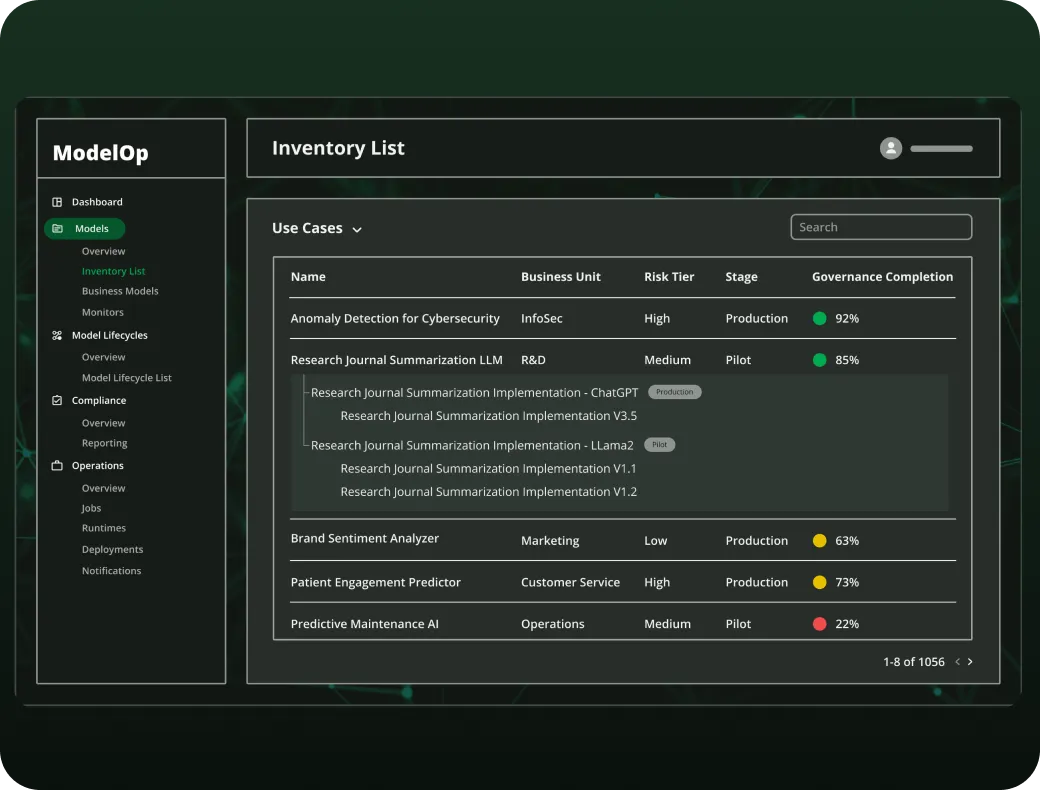
Key features include: Standardize AI use case intake and registration, Initiate the end-to-end AI lifecycle record, Automatically ensure business, risk, and portfolio reviews are conducted, Codify risk assessments for every AI use case, Auto-generate the risk tier for each use case, Auto-generate initial controls based on risk, Track and manage the vendor or internal solution details, Submit candidate AI solution through approval workflows to enforce reviews and policies.
ModelOp is commonly used for: Financial Services, Healthcare, Pharmaceuticals, Biotech, Consumer Packaged Goods Retail, Defense, Government, Public Sector, Chief AI Officer (CAIO), CDAO, CIO, AI Governance Teams Committees.
ModelOp integrates with: AWS SageMaker, Azure Machine Learning, Google Cloud AI, IBM Watson, DataRobot, H2O.ai, Alteryx, Tableau.
Based on user reviews and social mentions, the most common pain points are: token usage, API costs.

Shopping now starts in ChatGPT.
Oct 23, 2025
Based on 63 social mentions analyzed, 0% of sentiment is positive, 100% neutral, and 0% negative.