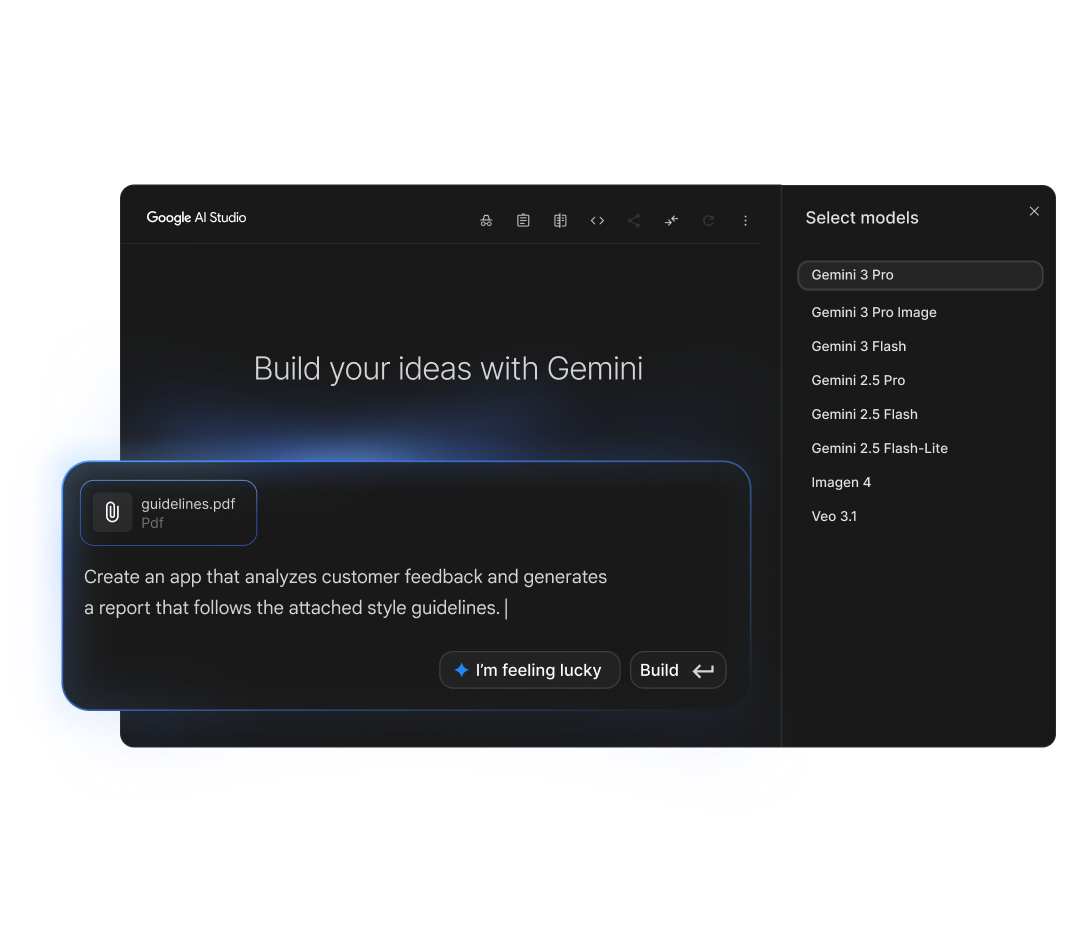
Build with Gemini 2.0 Flash, 2.5 Pro, and Gemma using the Gemini API and Google AI Studio.
Users generally praise Google AI for its robust and versatile capabilities, particularly highlighting the intelligent and rapid processing power of models like Gemini 3.1 Flash. The main strengths lie in innovation and integration with popular tools like Firebase, improving workflow and productivity. However, some users express concerns over the pricing structure, especially for top-tier subscriptions like Google AI Ultra, which costs $249.99. Overall, the reputation of Google AI remains strong, noted for cutting-edge technology and comprehensive support for developers and businesses.
Mentions (30d)
70
2 this week
Avg Rating
4.2
20 reviews
Platforms
7
Sentiment
7%
23 positive




Users generally praise Google AI for its robust and versatile capabilities, particularly highlighting the intelligent and rapid processing power of models like Gemini 3.1 Flash. The main strengths lie in innovation and integration with popular tools like Firebase, improving workflow and productivity. However, some users express concerns over the pricing structure, especially for top-tier subscriptions like Google AI Ultra, which costs $249.99. Overall, the reputation of Google AI remains strong, noted for cutting-edge technology and comprehensive support for developers and businesses.
Features
Use Cases
Industry
information technology & services
We’re launching a brand new, full-stack vibe coding experience in @GoogleAIStudio, made possible by integrations with the @Antigravity coding agent and @Firebase backends. This unlocks: — Full-stack
We’re launching a brand new, full-stack vibe coding experience in @GoogleAIStudio, made possible by integrations with the @Antigravity coding agent and @Firebase backends. This unlocks: — Full-stack multiplayer experiences: Create complex, multiplayer apps with fully-featured UIs and backends directly within AI Studio — Connection to real-world services: Build applications that connect to live data sources, databases, or payment processors and the Antigravity agent will securely store your API credentials for you — A smarter agent that works even when you don't: By maintaining a deeper understanding of your project structure and chat history, the agent can execute multi-step code edits from simpler prompts. It also remembers where you left off and completes your tasks while you’re away, so you can seamlessly resume your builds from anywhere — Configuration of database connections and authentication flows: Add Firebase integration to provision Cloud Firestore for databases and Firebase authentication for secure sign-in This demo displays what can be built in the new vibe coding experience in AI Studio. Geoseeker is a full-stack application that manages real-time multiplayer states, compass-based logic, and an external API integration with @GoogleMaps 🕹️
View original| Model | Input / 1M tokens | Output / 1M tokens |
|---|---|---|
| gemini-2.5-pro | $1.25 | $10.00 |
| gemini-2.0-flash | $0.10 | $0.40 |
| gemini-2.0-pro | $1.25 | $5.00 |
| gemini-1.5-pro | $1.25 | $5.00 |
| gemini-1.5-flash | $0.07 | $0.30 |
Light
1M tokens/mo
$0.16 – $5
gemini-1.5-flash → gemini-2.5-pro
Growth
50M tokens/mo
$8 – $238
gemini-1.5-flash → gemini-2.5-pro
Scale
500M tokens/mo
$83 – $2,375
gemini-1.5-flash → gemini-2.5-pro
Estimates assume 60/40 input/output ratio. Actual costs vary by usage pattern.
g2
What do you like best about Vertex AI?I use Vertex AI for content creation, improving workflows, and RAG purposes. It significantly cuts down the time spent on research and allows me to tailor output and formatting, which saves even more time. In terms of workflows, it helps produce copy at a faster rate and capacity while maintaining good quality, allowing us to scale. I love that Vertex AI is an enterprise solution with safety and compliance features. It's a great all-in-one tool for enterprises, capable of RAG, generative text/video/images, building agents, etc. It's just a nice playground to have access to for creating tools, and it's enabled my team and me to do things that were previously not possible. The access to generative AI with Google Search grounding and System Instructions customization is super advantageous, allowing my team to scale production of marketing copy effectively. Review collected by and hosted on G2.com.What do you dislike about Vertex AI?The UI is quite bloated. There are features that could be advertised better (or those that are in preview) like the AI Agent Builder. Depending on the user role, it could be better to adjust the UI to be more accessible and simple, perhaps by renaming some categories and features, including some documentation on the pages themselves. Review collected by and hosted on G2.com.
What do you like best about Vertex AI?I find using Vertex AI to be fun, which is an unexpected perk. The pricing is kind of affordable, making it a much more reliable option for me. I also think the reasoning behind its pricing is really good. Setting it up is quite easy, so that’s another strong point. Review collected by and hosted on G2.com.What do you dislike about Vertex AI?I think the vulnerability in experiments could be improved. It's something that really needs attention. Also, the SSS vulnerability needs improvement. Review collected by and hosted on G2.com.
What do you like best about Vertex AI?I use Vertex AI to build and run machine learning models, and I find it very helpful because it lets me work with data, train models, and make predictions all in one place without needing to set up everything myself. I love that I can try different models and compare results easily, which helps me understand what works best without a lot of manual effort. The AutoML feature is great too, guiding me through the steps, making the process easier even though I'm not a machine learning expert. I also appreciate how well Vertex AI integrates with other Google Cloud services, allowing me to use my data directly without moving it around, which saves me effort and keeps my work simple. This all makes my workflow faster, simpler, and more organized. Review collected by and hosted on G2.com.What do you dislike about Vertex AI?One thing that could be better is how easy it is to learn at the beginning. It can feel confusing if you are new and some steps are not very clear. Another issue is that it can be hard to understand the pricing. Costs can increase quickly if you are not careful and it is not always easy to track spending. Sometimes, when something goes wrong, it is also difficult to find the exact problem. Better error messages or guidance would help a lot. Review collected by and hosted on G2.com.
What do you like best about Vertex AI?it functions as a "powerful command center" for testing models and exposing endpoints, which helps streamline production grade software deployment. Review collected by and hosted on G2.com.What do you dislike about Vertex AI?Vertex AI for its steep learning curve and overwhelming complexity, particularly around setup, permissions, and resource management and unexpected high costs due to opaque pay-as-you-go billing and lack of clear warnings during free trials Review collected by and hosted on G2.com.
What do you like best about Vertex AI?I appreciate that Vertex AI helped us extract relevant points faster from documents, turning unstructured information into something we could easily present and share with stakeholders. I love the documentation and how it enabled us to quickly test different approaches from design to practical implementation, building the whole machine learning stack ourselves. Trying different models was also a plus due to its speed. The initial setup was very easy and straightforward, which made it convenient to start using quickly. Review collected by and hosted on G2.com.What do you dislike about Vertex AI?I guess the cost transparency while experimenting with different models and workflows. To be honest, understanding the cost part and where to put limits was a bit tiresome because we were afraid of doing something wrong and no hard stop on spending amount. Review collected by and hosted on G2.com.
What do you like best about Vertex AI?I like that Vertex AI automates a lot of the setup, making it easier to experiment with different models and turn them into APIs quickly. I appreciate how it orchestrates the models and deploys them as services, allowing easy integration into our app. It handles processing and analyzing large amounts of product data without needing to build ML infrastructure from scratch. Additionally, the integration with OCR tools for automatically flagging risky additives is a huge plus. It integrates easily with the rest of the Google Cloud ecosystem, making it simple to connect data, models, and scaffold real projects quickly. The initial setup was quite easy, which was beneficial. Review collected by and hosted on G2.com.What do you dislike about Vertex AI?I think Vertex AI could improve by providing better cost transparency and implementing safeguards to prevent overspending. I had to spend extra time reviewing the cost structure to ensure it stayed within safe limits. It would be helpful to have hard stops when the budget is hit or options for pre-paid budgets. Review collected by and hosted on G2.com.
What do you like best about Vertex AI?the usage of multimodality and agentic coding Review collected by and hosted on G2.com.What do you dislike about Vertex AI?I dislike the high costs, a steep learning curve, and complex, non-intuitive workflows Review collected by and hosted on G2.com.
What do you like best about Vertex AI?I like that Vertex AI brings the whole ML workflow into one platform and integrates well with Google Cloud services. It also saves time by handling infrastructures and scaling automatically. I also like how easy it is to deploy models and manage them through APIs. The platform is flexible and works well for both experimentation and production workloads. Review collected by and hosted on G2.com.What do you dislike about Vertex AI?One area that could be improved is the learning curve for new users, especially when configuring services in Google Cloud. Pricing and documentation could also be clearer for beginners. Review collected by and hosted on G2.com.
What do you like best about Vertex AI?The reliability that is offered by Vertex Ai is amazing Review collected by and hosted on G2.com.What do you dislike about Vertex AI?Well, to be frank, there’s really nothing to dislike. Review collected by and hosted on G2.com.
What do you like best about Vertex AI?Vertex AI Studio is easy to use, and the code output is downloaded for further development. Review collected by and hosted on G2.com.What do you dislike about Vertex AI?The complexity is high. I can access the product, but there’s no clear way to understand it because there isn’t an explanation of the code behind it. A README file would really help, and some visualization of how things work or how the different parts fit together is needed. Review collected by and hosted on G2.com.
Help Wanted: Opinions
Solo dev here. Building an AI companion that lives entirely on your device — no cloud, no account, no data ever leaving your phone. Coming soon to Google Play. Would love honest feedback. I genuinely just want opinions. It is not even available yet. I have been working on this for over a year. I am still building it. I started this project because a regular family budget like mine cannot just go out and purchase an AI companion robot. So I started with a cheap robot kit from Amazon — something my 9 year old son and I could build together. Then I thought... "What if I could give it a real brain?" I had an old Samsung Galaxy collecting dust and went to work. Scout is a calm AI companion that transforms an old phone into a friend. He listens, remembers, learns, and provides a warm family-safe presence — designed to feel less like an assistant and more like someone who is simply glad you are there. Everything runs offline. No account. No subscription. No data leaving your phone. Ever. I will need beta testers later — but right now I am just curious: What would make you look at something like this and think "that is actually kind of nice"? submitted by /u/CapeManCoral [link] [comments]
View originalMassive Thank you to Claude AI
Don’t know if this is the right place but recently for my coursework, ( A Level NEA Computer Science) it suddenly disappeared from my google drive ( not sure if my ex revenge deleted it or my mum ). and i had no back ups because i never expected this. i mainly used ChatGPT back then but after 30 days the files get deleted from the chat. However, i pasted my whole write up to Claude including the code to it to check for minor improvements and 6 months later it is still there which saved me months of work. all i had to do was format it and 3 days later good as new. Im glad Claude AI doesn’t delete files sent, completely saved me big time it genuinely saved my uni offer. submitted by /u/Due-Plenty-8744 [link] [comments]
View originalI used Claude Code to build a free Pokémon personality profiler from scratch in one session
Hey r/ClaudeAI, I built NotRandom (notrandom.vercel.app) a free web app where you type your favorite Pokémon and get a psychographic profile based on your choice. The premise: your favorite Pokémon is not random. It reveals something real about you. What it does: Fetches the Pokémon's types and Pokédex lore from PokéAPI Classifies it into one of 10 archetypes (The Sovereign, The Rebel, The Shadow Operator, The Jester...) Generates a Core Identity, Shadow Side, a unique nickname ("The Calculated Vanishing" for Greninja), and a one-liner "The Line" designed to feel uncomfortably accurate Lets you download a 1080x1080 shareable image card How Claude Code specifically built this: Everything was written by Claude Code in a single session. Here's what it actually did: Full architecture I described the concept, Claude Code planned the stack (React + Vite + Tailwind + Vercel serverless) and the complete file structure before writing a single line All React components from scratch LandingPage, LoadingScreen, ProfileCard, ShareCard, state machine in App.tsx The archetype system designed and coded the mapping of all 18 Pokémon types to 10 personality archetypes with color palettes per type The Claude Haiku prompt engineered to return a structured JSON with the right tone (intelligent, slightly poetic, never cringe) Solved a real architectural problem — the Anthropic API blocks direct browser calls (CORS). Claude Code diagnosed it, then created a Vercel serverless /api/profile route to proxy the call server-side Debugged the share card the downloaded image was black. Claude Code identified two causes: position: fixed breaks html-to-image's canvas renderer, and Google Fonts fail silently during capture. Fixed with skipFonts: true + sprite conversion to base64 before capture Full deployment Vercel config, environment variables, 30s timeout for cold starts I described what I wanted, Claude Code wrote the code, I tested, reported what broke, it fixed. Classic loop. https://preview.redd.it/i62hsrbd0n4h1.png?width=1080&format=png&auto=webp&s=aa31a839f094fa5760e401e8f336b01efbb49179 Free to use: https://notrandom.vercel.app no login, just type any Pokémon name in English (all 1025 are supported). submitted by /u/dyloum84 [link] [comments]
View originalI stopped using Claude in the browser for 80% of my daily tasks and my usage actually went up
This is going to sound counterintuitive but let me explain. I love Claude. I use Opus for deep work, Sonnet for quick stuff. I was probably using claude 15 to 20 times a day. Summaries, brainstorming, code review, email drafts, research questions. Standard knowledge worker usage. But I noticed a pattern. Most of my usage happened in bursts. I would open Claude, do 4 or 5 things, then close it and not come back for 3 hours. Not because I did not need it, but because I forgot about it. I was deep in something else and the thought "I should ask Claude about this" did not occur to me in the moment. So I built a small thing. An agent that runs Claude Sonnet on the backend, connected to my calendar, todoist, email, and a few notion databases. It lives as a contact in my iMessage called "C" (very creative I know). Now instead of opening claude when I remember to, I text C throughout the day the same way I text anyone else. "What is on my calendar after 3pm." "Draft a reply to that email from alex, keep it short, say yes to the timeline." "Remind me to review the pitch deck before tomorrow's call." "What did I write in my product notes last week about the onboarding flow." My actual Claude usage went UP significantly. Not because the model got better but because the access point changed. Texting is a zero-friction action I already do 80 times a day. Opening a browser tab is a deliberate decision I have to remember to make. The deep work still happens in claude.ai. When I need the full context window, artifacts, file uploads, the browser is still better. But that is maybe 20% of my interactions. The other 80% are quick, context-specific queries that take 30 seconds and are perfectly suited to a text message. Stack: claude sonnet via API, a small express server for the tool integrations (google calendar, todoist, notion, gmail), photon codes for iMessage delivery, deployed on a $7 render instance. Langfuse for tracing when something goes weird. Total cost is about $35 a month in API calls which is less than what I was already spending on the Pro subscription that I still also have. The meta point: Claude is incredible. The browser is holding it back for most daily use cases. Not because the browser is bad but because it requires intent. The best AI interactions are the ones that happen when you barely think about it. submitted by /u/ScaryAd2555 [link] [comments]
View originalYou can chat with the AI in google search
Wow. Wow! Even the Ai can talk! submitted by /u/Proud-Environment754 [link] [comments]
View originalSomething I’ve been wondering lately
Big platforms are racing to integrate AI into everything. LinkedIn, Google, Microsoft and Meta they all want AI handling tasks, recommendations, outreach, content, and workflows. But the moment regular users try to use AI as a real assistant on those same platforms, it suddenly becomes a ToS issue. I’d love to use Claude as an actual personal assistant to manage emails, help with LinkedIn, handle routine web tasks but most sites seem designed to stop that from happening. When I tried giving Claude browser access, I spent more time worrying about account flags, automation detection, and unintended actions than I saved through automation. So how are people actually doing this? Are you avoiding sites like LinkedIn entirely? Only using AI for drafting and research? Or have you found a setup where you can genuinely delegate tasks without constantly supervising it? It feels like AI assistants are finally capable enough, but the platforms themselves don’t really want users having that level of automation. TL;DR: AI is being built into big platforms, but when users try to use it as a real assistant on those same platforms, it quickly runs into restrictions. Curious how people are actually working around that gap. submitted by /u/Litun1 [link] [comments]
View originalMy wife tried to log 1k phone-free hours but quit. So I vibe-coded an app
This past summer, my wife set an audacious goal: she wanted to log 1,000 hours of phone-free time with our family. To track it, she’d put away her phone and start a manual timer. At first, it was great. But between managing two young kids and constantly forgetting to start or log the timers, the friction just became too much effort. After about 120 hours, she gave up. I wanted to find a way to handle the data collection for her so she could just focus on being present. The problem is, I’m a school teacher with a very limited, hobbyist programming background. I had never created anything close to a native Android app before. With all the recent talk around "vibe-coding" and AI agents, I figured I’d see if I could cobble a solution together. The result is Green Dot. It’s a native Android app built with Kotlin and Jetpack Compose. The core philosophy is pretty simple: not less phone, just better phone habits. Instead of being a punitive screen blocker, it tracks your long lock durations and rewards you for taking intentional, 1-hour breaks away from the device. The development process honestly went way beyond my expectations. I used VS Code (leveraging the education benefits) and did the vast majority of the heavy lifting using Claude Sonnet. After a couple of days of prompting and debugging, I had a working prototype. After about three weeks of working in my spare time, I had a fully functional app live on the Play Store. As someone without a formal CS background, it’s wild to me that these tools can democratize software development to this extent. It’s obviously not going to replace a software company, but it allowed a parent to ship a real, working tool over a few weekends to solve a hyper-specific lifestyle problem. My wife is back to tracking her hours, and I've shared it with a few friends and family who have found it useful for disconnecting. I’m sharing it here because I'd love to get the community's thoughts—both on the psychology of rewarding lock durations rather than locking users out, and on the technical side of spinning up a native mobile app from scratch using LLMs if you've done something similar. Play Store Link: https://play.google.com/store/apps/details?id=com.greendot.phonebreaks submitted by /u/starcraftgamerz77 [link] [comments]
View originalHow does AI help with Job productivity?
For Context: I work in a semiconductor manufacturing company as a modelling engineer, I use some modelling softwares etc but none of them use AI. I wanted to understand the whole AI craze nowadays, people say that AI will replace jobs/Increase productivity and I don't get it at all. All I see is a simple chatbot (ChatGPT) which is a super impressive version of google and can solve some basic math/science questions and Co-Pilot in my workplace which I found to be useless, for example the facilitator thing which is supposed to make meeting notes is so bad at summaring meeting minutes etc. I don't think AI is there yet to do very basic things. So yes in theory if AI gets better in few years/decades sure it take the non-technical part of my job like making meeting minutes/making ppt's etc but I think its still not there yet. For AI to take over my job it needs to get the basic shit correct first and then maybe it can do the technical stuff. One really good use-case of AI that i can see is to generate Code based on the project requirement, So I can see how entry level coder's jobs might be affected sure, but that's a very small portion of the economy, right? submitted by /u/the_axe_effect [link] [comments]
View originalGoogle’s AI mode is threatening me… i was just trying to look up a family guy clip…
submitted by /u/Early_Mail9268 [link] [comments]
View originalClaude Cowork & Meta/Google Ads
Somewhat new to AI. I’ve been working on Cowork the last few weeks on my wife’s wedding photography business. Her old website was a slightly modified Squarespace template that was out of date, terrible seo, no AEO, and just, needed to go. She worked with a branding company and has a great brand, fonts/colors/styling, and I fed that to a project and have been working on a full redesign on Wordpress that is almost ready to launch. Fully SEO/AEO optimized and all that. Now I’ve had Cowork (in the same project) help me plan a marketing launch for the new site, and addition to a content plan for organic posts, we’ve built out a $30/day paid ads plan for Meta/Google. Has anyone got connected to Google and/or Meta through Cowork? I know Meta has an MCP Server but haven’t dove into that yet. I want something that from my Claude Cowork project, I can ask it how the ads are performing relative to our plan, create/edit campaigns and ads, and adjust as needed according to the plan. submitted by /u/johnnyglass [link] [comments]
View originalI built a full app with Lovable + Claude + Gemini and it has 100+ real users. Here's what actually worked.
I'm a software engineer but never had a fullstack/frontend development experience . I wanted something on the internet I could call mine, so I built Earnest — a free app that helps people track bank account bonuses (open account, meet requirements, collect bonus, close it, repeat). The stack: Lovable for the UI and scaffolding, Claude + Gemini with Google Antigravity to make complex parts work. What surprised me: - Lovable got me from 0 to something real embarrassingly fast - Claude was much better at understanding *intent* when I described the full user flow instead of individual features - Gemini was useful as a second opinion when I was stuck - The hardest part wasn't the AI — it was knowing what to ask for Where it landed: 19+ active promotions, $9,700+ in available bonuses tracked, 100+ users, $5,000+ in bonuses earned by users so far. App: earnest.lovable.app Happy to share more about the build process — what prompts worked, what completely failed, how I debugged without being able to read the code properly. submitted by /u/Any-Constant [link] [comments]
View originalBecoming a power user
Hi all, I use Claude across both personal (free tier) and work (enterprise) as a thinking partner for reasoning and research. I have a technical but mostly customer-facing role, and I can code at a basic level. I’ve been following the AI space pretty closely for about a year now, but I feel like I’m still scratching the surface of what’s actually possible. What finally unlocked AI as a genuine tool for you and not just a smarter Google search? Prompting habits, specific use cases, workflows? Big or small, I’d take any tips. submitted by /u/jkwnbn [link] [comments]
View originalLooking for vibe-research collaborators on “One-pass context-to-weight consolidation”
I’m a software engineer and AI enthusiast who wants to get involved with AI research, but I don’t have the full requisite math, ML coding chops, or compute needed to do typical research. I’m writing this post because I assume there are many other sub members in my boat, and i think i have a meaningful research problem with a shape that allows people like me to make progress. I explain the problem and why it’s tractable by people like this at length in the google doc linked in the comment of this post, but in essence: I believe there’s a chance there’s some mathematical rule that allows you to cheaply imbue the in-context understanding a model gains directly into its weights. IF a rule like this existed, then checking if you’ve found it requires very little compute. The core loop requires running the input token forward passes of a model large enough to learn in context (for reference, a 1 billion parameter model can do this and runs on a mac book pro), apply this rule (which, by the hypothesized construction of where in the solution space we’re looking, is computationally cheap), then quiz the model without the context on what it demonstrably knew in context / run regression benchmarks to make sure the application of the rule didn’t damage the model’s other capabilities. Although checking if you’ve found this rule is computationally cheap, proposing and implementing candidate rules is very difficult. It requires diverse mathematical and machine learning expertise, along with the scientific rigor to guide the search process. Up until now, there were very few people with access to those abilities. However, this is changing with modern frontier models. OpenAI and Anthropic both have soon to be released models capable of valuable mathematical work (re the erdos unit distance problem solved by the internal OpenAI model and Mythos). My proposal is to form a research community of “citizen scientists” to make progress on this problem. It’s possible the solution doesn’t exist, or is so incredibly complicated that modern frontier models have no hope of solving it. But, my argument is that for the first time, the solution is plausibly within reach of model capabilities. This, in combination with the immense upside of LLMs being able to cheaply learn from experience, makes researching it very high expected value. Participating in this community would involve sharing results, progress, benchmarks, and research insights. To productively contribute, rough requirements are: a 200 tier AI subscription a computer ~ as capable as a mac book pro M3 chip / willingness to pay 10 bucks a day for the cloud compute, A working knowledge of how LLMs function and the field of AI / cognitive science. submitted by /u/Independent-Soft2330 [link] [comments]
View originalCave Prompt: Making AI understand your requirements better
[Showcase] Cave Prompt — A Semantic Prompt Compiler for Claude Code 👉 Check out the repo here: Link Have you ever written a detailed request, sent it to an AI, and gotten an answer that was technically correct but completely missed the point? The AI isn't the problem—it's the "noise" in your prompt. Key constraints get buried at the end, or the core intent gets lost in conversational filler. Cave Prompt is a compiler skill that runs before your AI processes your request. It extracts your true intent, surfaces hidden requirements, resolves conflicting constraints, and restructures everything into a high-density execution prompt—so the AI works on what you actually need, not just what you literally said. Key Advantages: Attention front-loading: Critical constraints go first, where the model weighs them most heavily. Hidden requirement extraction: Finds what you didn't explicitly say but genuinely need. Constraint conflict resolution: Catches contradictions before the AI goes in the wrong direction. Vague → specific: Transforms fuzzy ideas (e.g., "track my finances") into structured specs (e.g., "a 3-sheet Google Sheets dashboard with SKU-level margin tracking"). Who is this for? Non-technical users: Those who describe things conversationally and aren't sure how to structure a prompt. Product managers & business owners: Anyone who knows what they want but struggles to translate it into precise AI instructions. High-stakes tasks: Anyone where a misread from the AI would cost real time or money. Teams: For standardizing prompt quality across members with different communication styles. When to use it: Use it for long, multi-constraint requests where clarity matters. Skip it for simple, single-intent prompts—the overhead isn't worth it there. This is my first skill build, so there may be rough edges—I truly appreciate your patience and any feedback you might have! As a developer, I’m putting a lot of heart into this project. A ⭐ on the repo would be a huge boost for my work and personal growth—it really motivates me to keep building and improving. If you find the idea useful, I’d be incredibly grateful for the support. Thanks for reading and for helping me grow! 🙏 submitted by /u/hieudeptrai1962000 [link] [comments]
View originalFrom Making $200 to $20K/Month Offering Free Website Drafts
So I’m writing this for anyone running a web agency who’s struggling to get consistent clients or build scalable systems. I understand how stressful it can be because I was in the exact same position. I’ve been running my web agency for 4 years, but only in the last year did I start using AI seriously, and honestly it changed everything for me. I used to build websites on WordPress and do all my outreach manually. It worked, but it was inconsistent and exhausting. Once I started implementing AI into my business, I went from constantly chasing clients to doing around $20k/month recurring. This is basically what changed for me. At first I was targeting businesses with no websites, but switching to businesses that already had websites worked way better. There are SO many businesses with outdated websites that clearly need upgrading. Plus, these business owners already understand the value of having a website because they’ve already paid for one before. It’s way easier convincing someone to improve something they already believe in than trying to convince someone from zero. The second big shift was moving from manual outreach to automated email outreach that actually feels personalized. Instead of sending generic emails, I now use a tool that mass analyzes a business’s website and generates personalized outreach based on things like design issues, SEO problems, site speed, mobile optimization, and overall user experience. The third thing that changed everything was offering a free redesigned draft version of their current website. Realistically, who says no to free? I can build these drafts really quickly using Claude Code, and most of the time they already look way more modern than the client’s existing site. Once business owners see a better version of their own company in front of them, selling becomes way easier. Another huge mistake I used to make was just sending preview links through email. They open it later when they’re busy, nobody’s there to explain the improvements properly, and eventually the lead goes cold. Now I always present the website live on Google Meet and try to close them on the spot. That alone massively increased my close rate. Also, always charge upfront for the website build, but don’t ignore monthly recurring revenue. Hosting, maintenance, edits, SEO, ongoing changes, etc. That’s where stability comes from if you actually want predictable income every month instead of constantly hunting for new clients. For anyone curious about the tools I use, it’s honestly pretty simple. Apollo for finding leads because you basically never run out of businesses to contact. Swokei for outreach. I upload my lead list there and it analyzes each business website, scores it, and turns flaws in design, SEO, speed, and mobile optimization into personalized outreach emails automatically. Pointing out actual issues on their website increased my reply rates massively. Claude Code for building websites. And honestly, people saying AI built websites don’t perform well are just wrong. If you know what you’re doing, you can build pretty much anything now. And Cloudflare for hosting client websites. That’s pretty much the system I run now. submitted by /u/Murky_Explanation_73 [link] [comments]
View originalGoogle AI uses a tiered pricing model. Visit their website for current pricing details.
Google AI has an average rating of 4.2 out of 5 stars based on 20 reviews from G2, Capterra, and TrustRadius.
Key features include: Build with Gemini, Customize Gemma open models, Run on-device, Build responsibly, Integrate Google AI models with an API key, Integrate models into apps, Explore AI models, Own your AI with Gemma open models.
Google AI is commonly used for: Build with Gemini.
Google AI integrates with: Google Cloud Platform, Firebase, TensorFlow, Kubernetes, Chrome, Android, Web APIs, Google AI Studio, Gemini API, Gemma models.

Noam Shazeer
CEO at Character.AI
3 mentions
Based on user reviews and social mentions, the most common pain points are: down, token usage, API costs, LLM costs.
Based on 348 social mentions analyzed, 7% of sentiment is positive, 91% neutral, and 2% negative.